


Image Source: unsplash
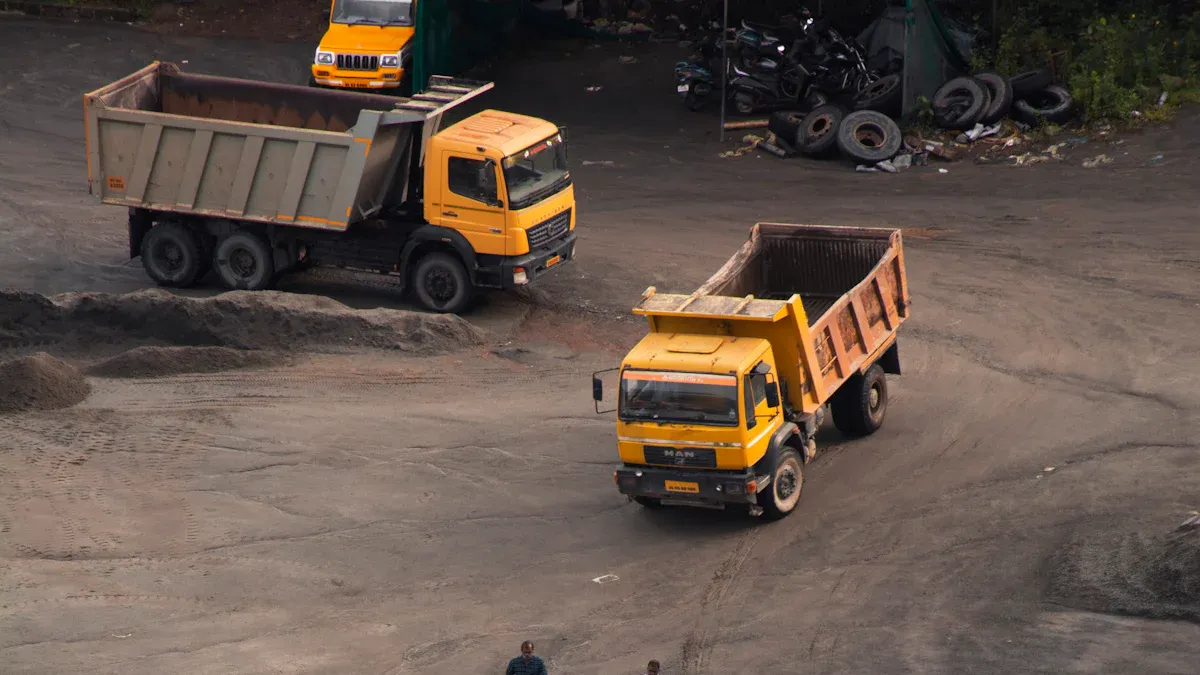
You see many different types of dump trucks on job sites. Each dump truck serves a special purpose and fits certain industries. Some, like rigid dump trucks, carry huge loads in mining. Others, such as articulated dump trucks, handle rough terrain and tight turns in construction. The main types of dump trucks differ in design, load size, and how they unload materials. If you want to choose the right dump truck, you need to know what makes each one unique and how they match your project needs.
Key Takeaways
-
Learn about the types of dump trucks. This helps you pick the best one for your job. Each type works well for certain tasks.
-
Think about how much the truck can carry and where it will drive. Make sure the truck fits your material and the ground at your site.
-
Safety is very important when using dump trucks. Always look at the ground first. Use a spotter to help guide you. Wear safety gear to stay safe.
-
Articulated dump trucks work well on bumpy ground. Standard dump trucks are better for city streets. Pick the right truck for your work area.
-
Knowing what your project needs will help you choose. Check what you need to move and any rules in your area.
Types of Dump Trucks
You see many types of dump trucks at job sites. Each type has special features for certain jobs. Knowing about these types helps you pick the best one for your project.
Standard Dump Truck
A standard dump truck is very common. You often see it in construction and mining. It has a chassis and a dump body with a hydraulic lift. This makes unloading fast and easy. Standard dump trucks move well in cities. They have different axle setups for different loads.
|
Feature/Application |
Description |
|---|---|
|
Design |
Chassis with dump body and hydraulic lift |
|
Maneuverability |
Smooth navigation in urban areas |
|
Multiple axle options for different loads |
|
|
Common Industries |
Construction and mining |
|
Typical Materials Transported |
Construction waste, gravel, soil, heavy materials |
You can choose a standard dump truck by axle number and load size.
|
Truck Configuration |
Number of Axles |
|
|---|---|---|
|
2-Axle Truck |
2 Axles |
10-20 Tons |
|
3-Axle Truck |
3 Axles |
20-30 Tons |
|
4-Axle Truck |
4 Axles |
25-35 Tons |
|
6-Axle Truck |
6 Axles |
30-40 Tons |
Transfer Dump Truck
A transfer dump truck can carry bigger loads than a standard dump truck. It has a cargo container that moves into the main body for fast unloading. This makes transfer dump trucks good for big construction and mining jobs. Drivers need special skills because it is harder to use.
|
Feature |
Transfer Dump Truck |
Standard Dump Truck |
|---|---|---|
|
Load Capacity |
Larger loads |
Standard loads |
|
Design |
Movable cargo container |
Fixed cargo bed |
|
Operational Complexity |
Requires skilled drivers |
Simpler operation |
|
Common Uses |
Large-scale construction, mining |
General hauling |
Transfer dump trucks are used in construction and waste management. You see them in North America, Europe, and Asia Pacific. They are popular for moving lots of material far distances, especially in city building and big projects.
End Dump Truck
An end dump truck uses a hydraulic lift to raise the front of the bed. It unloads from the back. This works well for sand, gravel, and demolition debris. You can unload quickly, but safety is important.
|
Unloading Mechanism |
Design Features |
|
|---|---|---|
|
End Dump Trucks |
Lifts bed at front to unload from rear |
Efficient for bulk materials |
Safety Tips for End Dump Trucks:
Train drivers to spot dangers like soft ground and uneven spots.
Do not park near trenches or holes.
Stay away from power lines when lifting the bed.
Workers should wear bright clothes.
Use traffic control in work areas.
Use scales to check weight and follow rules.
Always use a spotter when backing up.
Side Dump Truck
A side dump truck unloads by tilting the box to the side. Hydraulic systems tilt the trailer between 45 and 50 degrees. This lets materials slide out fast. The design stops blockages and speeds up unloading. Side dump trucks work well in tight spaces and stay stable.
|
Type of Dump Truck |
Unloading Mechanism |
Design Features |
|---|---|---|
|
Side Dump Trucks |
Rotates dump box on midline axis |
Can dump on either side, prone to spilling |
-
Side dump trailers unload faster than rear dump trucks.
-
They need less hydraulic pressure, so they last longer.
-
Dumping both ways gives you more choices.
-
The design keeps the truck steady when unloading.
You can use side dump trucks for:
-
Aggregate and sand: Controlled dumping and windrowing.
-
Demolition debris: Handles big loads with less jamming.
-
Dirt and excavation: Fast dumping and moving.
-
Storm and disaster cleanup: Removes mixed debris quickly.
Tri-Axle Dump Truck
A tri-axle dump truck has three axles. This spreads weight evenly. You can carry heavier loads and follow road rules. Lift axles help meet bridge rules and avoid fines.
|
Advantage |
Description |
|---|---|
|
Weight Distribution |
Extra axle spreads weight, reduces impact on each axle |
|
Compliance |
Lift axles help meet bridge rules |
|
Heavier Loads |
Carries more than two-axle trucks |
Tri-axle dump trucks are great for moving bulk goods and construction materials.
Superdump Truck
A superdump truck uses a trailing axle to make the axle longer and carry more weight. You can haul more while following bridge laws. This design lets you carry more than a standard dump truck.
|
Feature |
Description |
|---|---|
|
Trailing Axle |
Strong Arm® trailing axle increases axle length |
|
Payload Capacity |
Carries more weight, complies with bridge laws |
|
Comparison to Standard Dump |
Higher payloads due to design advantages |
|
Industry |
Use Case |
|---|---|
|
Construction |
Transporting dirt, gravel, sand, rocks |
|
Mining |
Moving ore, coal, minerals |
Superdump trucks are used in big hauling jobs in construction and mining.
Bottom Dump Truck
A bottom dump truck, also called a belly dump trailer, unloads through a gate at the bottom. This lets you spread sand and gravel over large areas. You can place materials exactly where you want, which is important for roadwork.
Bottom dump trucks move:
-
Gravel
-
Sand
-
Dirt
You get fast material placement and even spreading, especially for roadwork.
Articulated Dump Truck
An articulated dump truck has a jointed frame. The front and back parts move separately. This keeps wheels on the ground and improves grip and balance on rough land. You can turn tight corners and fit in small spaces. The steering system lowers torque and pressure on the chassis, so the truck stays steady on rocky ground.
Maneuverability Note:
The articulated design lets you turn tighter, which helps on tough terrain.
Articulated dump trucks are used in mining and off-highway dump trucks jobs. You can carry heavy loads over rough ground.
|
Model |
Rated Payload (kg) |
Rated Payload (lb) |
|---|---|---|
|
DA45-5 |
40,600 |
89,507 |
|
Caterpillar 795F AC |
338,000 |
745,000 |
|
Komatsu 960E-1 and 960E-1K |
360,000 |
793,664 |
|
Volvo A60H |
61,000 |
134,000 |
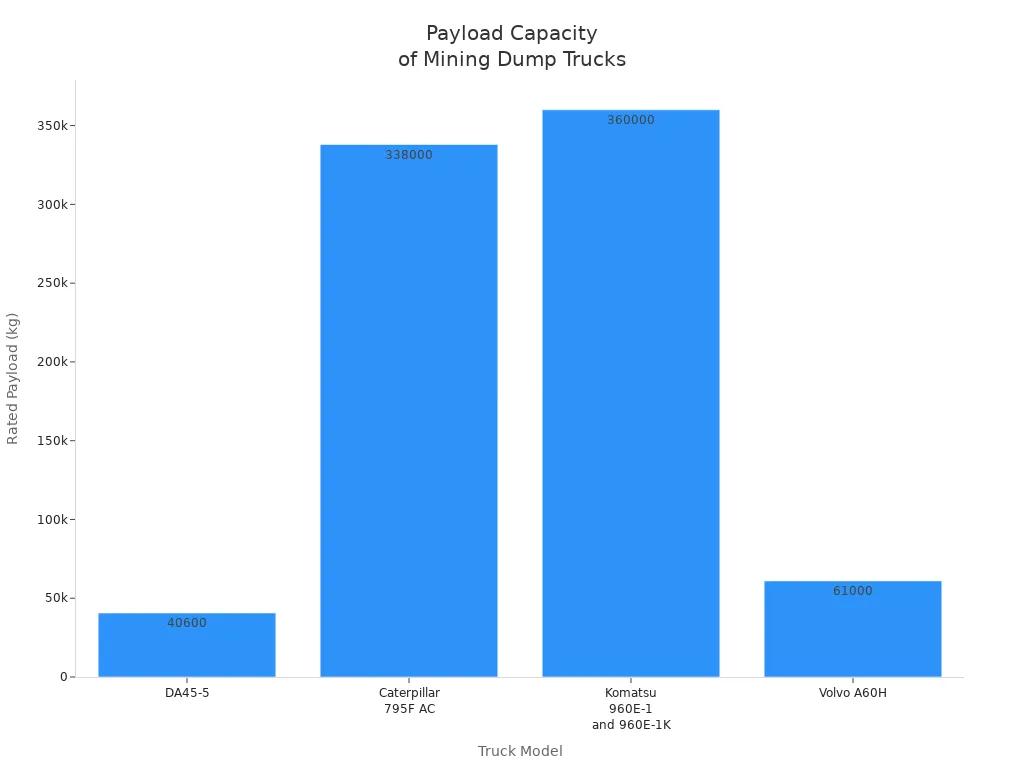
You can use articulated dump trucks for mining, construction, and off-highway dump trucks jobs that need high payloads and good turning.
Uses of Dump Trucks
Construction Applications
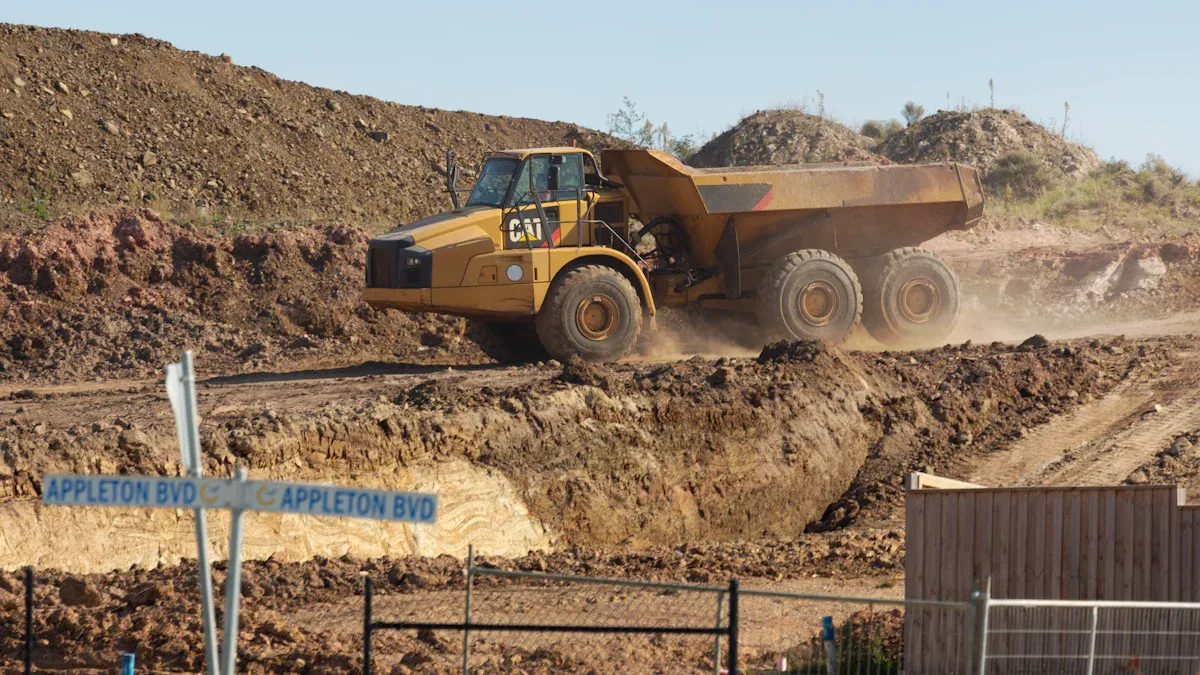
Dump trucks are everywhere on construction sites. The construction industry uses dump trucks more than any other field. New roads and buildings make the need for dump trucks go up. In 2024, construction uses 44% of all dump trucks. This number will get bigger as cities grow. Dump trucks move dirt, gravel, and trash. Articulated dump trucks and off-road dump trucks are best for big jobs. Their strong suspension helps them drive on rough ground. Side dump trucks are good for unloading in small spaces. You pick the right truck for the material you need to move.
-
Construction jobs for dump trucks:
-
Carrying soil and rocks
-
Taking away broken building parts
-
Bringing sand and gravel
-
Construction dump trucks help you work faster and safer by moving materials quickly.
Roadwork and Paving
Dump trucks are important for roadwork and paving. Standard dump trucks bring things like asphalt and gravel. Construction/slag dump trucks move dirt in cities. Hydraulic lifts help you unload fast. Beds that tilt let materials slide out easily, which keeps the worksite safe.
|
Truck Type |
Application |
Terrain Adaptability |
|---|---|---|
|
Construction/Slag Dump |
Urban construction and earthmoving |
Complex construction sites |
|
Standard Dump Truck |
Residential and roadway construction |
Standard streets and highways |
-
Safety and speed benefits:
-
Hydraulic tailgates control how much comes out.
-
Rear cameras and alarms help drivers stay alert.
-
Load systems stop trucks from carrying too much.
-
You can work faster with better loading and smart planning. GPS tracking helps you plan deliveries and avoid waiting.

Mining and Off-Road Uses
Mining needs dump trucks to move heavy stuff. Mining dump trucks carry sand, gravel, and ore. These trucks can handle rough ground and big loads. Articulated dump trucks are great for off-road jobs. You use them where normal trucks cannot go. Off-road dump trucks are strong and last a long time in tough places.
-
Mining dump trucks move loose rocks on special roads.
-
They work in hard weather and big work sites.
-
You count on them to move mined materials quickly.
Material Transport
Dump trucks move lots of materials in many jobs. End dump trucks and side dump trucks carry medium loads on building sites. Bottom dump trucks are good for quarries and landfills. You pick the truck based on your job, how much you need to carry, and the ground.
|
Construction Site (On-Road) |
Quarry (Off-Road) |
Landfill (On & Off-Road) |
|
|---|---|---|---|
|
Dump Type |
End-Dump, Side-Dump |
Bottom Dump |
End-Dump, Side-Dump, Bottom Dump |
|
Payload |
Medium |
High |
High, Variable |
|
Maneuverability |
High |
Medium |
Medium to Low |
|
Terrain |
Paved, Smooth |
Rough, Uneven |
Varied |
|
Maintenance |
Regular |
Often, Hard Work |
Often |
You think about safety, repairs, and cost when picking a dump truck. Picking the right size truck helps you work better and avoid fines.
Dump trucks are used for building, roadwork, mining, and moving materials. You choose the best truck for your job to keep work going well.
Choosing the Right Dump Truck
Assessing Project Needs
First, look at what your project needs. Think about what you will move and the ground at your site. Check your budget and see if there are any local rules about truck size or use. Ask yourself what jobs the dump truck must do. Figure out how much you need to carry. Learn about the different dump trucks.
-
What materials you need to move
-
What the ground is like
-
How much money you can spend and fix costs
-
Local rules you must follow
-
What you want the truck to do
-
How much it can carry
-
Which dump truck type fits best
Capacity and Payload
Pick a dump truck that can carry what you need. Sand, gravel, and rocks all weigh different amounts. The size and how often you haul help you choose a big or small truck.
-
Light-duty dump trucks are good for small jobs and tight spots.
-
Mid-range dump trucks work for medium-sized sites.
-
Heavy-duty dump trucks are for big jobs and can carry up to 50 tons.
-
Extra-heavy duty dump trucks are best for mining and very heavy loads.
|
Truck Type |
Capacity (Tons) |
Best Use |
|---|---|---|
|
Light-duty |
Up to 6.5 |
Landscaping, small jobs |
|
Mid-range |
6.5 - 30 |
Construction |
|
Heavy-duty |
30 - 50 |
Large projects |
|
Extra-heavy duty |
Over 50 |
Mining |
Terrain and Accessibility
Think about the land and job site. The ground, dirt, and weather can change how a dump truck works. Articulated dump trucks and off-road dump trucks are best for rough or bumpy ground. Their strong parts and special joints help them move in mud, sand, or rocks. All-wheel-drive trucks grip better in hard places.

Industry Suitability
Pick a dump truck that fits your job field. Construction, mining, and waste jobs need different trucks. Loose rocks, heavy stones, or dangerous stuff need special trucks. Big jobs need trucks that can dump a lot. Daily jobs may need smaller trucks. Choose the right size and type to work better and stay safe.
Tip: Always check your project needs, job site, and what you will move before you pick a dump truck.
You gain a big advantage when you know the different types of dump trucks and their uses. Picking the right truck helps you work faster and safer.
-
Check your project needs before you choose.
-
Look at payload and terrain.
-
Match the truck to your job for better results.
Remember: The right dump truck makes your project easier and more efficient. You have the power to make smart choices for your next job.
FAQ
What is the main difference between a standard dump truck and an articulated dump truck?
You drive a standard dump truck on paved roads. You use an articulated dump truck for rough terrain. The articulated model bends in the middle, so you turn easily and stay stable on uneven ground.
How do you choose the right dump truck for your project?
You look at your material, payload, and job site. You check the ground and space. You pick a truck that fits your load and works well in your environment.
Can you use a dump truck for both construction and mining?
You can use some dump trucks for both jobs. Articulated and superdump trucks work in construction and mining. You choose based on load size and terrain.
What safety tips should you follow when operating a dump truck?
Always check the ground before unloading. Wear bright safety gear. Use a spotter when backing up. Keep clear of power lines. Manage loads to prevent tipping.
Which dump truck type is best for spreading materials evenly?
You use a bottom dump truck for even spreading. The gate at the bottom lets you place sand or gravel in a straight line, which helps with roadwork.


