


description: "Shopping for a kid's RC car? We rank 7 models for ages 4-12 by scale, motor and run time - every spec cited. Find the right holiday gift in minutes."
slug: best-rc-cars-for-kids-2026
canonical: https://zd-pro.com/blogs/news/best-rc-cars-for-kids-2026
og_type: article
og_title: "Best RC Cars for Kids in 2026: The Ultimate Holiday Gift Guide"
og_image: https://zd-pro.com/cdn/shop/files/RCmonstertruck_9.webp?v=1780383647\&width=1200
og_image_alt: "ZD-pro 1:18 scale 4WD RC monster truck driving on gravel"
twitter_card: summary_large_image
keywords: best rc cars for kids, rc car for kids, kids rc truck, holiday gift guide, remote control car for children
author: ZD-pro RC
date: 2026-10-01
---
Best RC Cars for Kids in 2026: The Ultimate Holiday Gift Guide
Choosing an RC car for a child looks simple until you are standing in front of forty different boxes. Scale numbers, brushed versus brushless motors, run times, and battery types all blur together — and the wrong pick usually ends up in a closet by January.
This guide is built on a single test: every recommendation has to be justified by a number you can check on the product page, or by a published standard you can look up. We group the picks by age band, cite real specifications from our product listings, and mark each claim with its source. Where we are relying on our own product data rather than an independent authority, we say so.
If you want to browse the full range while you read, start with the Holiday Bestsellers collection or jump straight to all RC off-road cars.
Not sure which age band you need?
Start with our most-gifted model — the 1:18 4WD Monster Truck, rated by ZD-pro for kids 4+ with a 24-minute run time and four built-in protections. It is the safest first RC car in this guide.
How to Choose an RC Car for a Child (Without Overthinking It)
Before the picks, three variables matter more than anything else on the box — and each one can be settled with a specific figure rather than a feeling.
Scale: the single most useful number
Scale is a ratio between the model and a full-size vehicle, and it is the fastest way to predict both the size and the driving space a car needs. Industry size guides map each scale to a typical body length, which turns a vague ratio into a number you can measure against your living room:
|
Scale |
Typical length |
Everyday comparison |
Who it suits |
|---|---|---|---|
|
1:10 |
17–23 in |
Briefcase or carry-on |
Most users; yards and parks |
|
1:16 |
9–13 in |
Dinner plate |
Beginners; light outdoor and indoor |
|
1:18 |
8–10 in |
Hardcover book |
Small spaces and indoor use |
|
1:24 |
4–8 in |
Smartphone |
Indoor fun; maximum portability |
Source: VRX Racing scale-size guide and RC Cars Guide scale chart, both of which publish inch measurements for each scale.
Two independent guides converge on the same conclusion for children specifically. RC Cars Guide states plainly that for "kids under 10," the 1:18 scale is "the sweet spot for young drivers — durable, manageable speed," while warning that 1:24 models "can be fragile until you learn the hobby." That matches the 8–10 inch footprint above: big enough to be a real machine, small enough that a child can carry it and drive it in a hallway.
For most children under ten, 1:18 to 1:20 is the sweet spot — and the numbers above are why: a 1:18 car is roughly the length of a hardcover book, so it works indoors, and its lighter mass means battery packs are smaller and charge cycles shorter.
Brushed vs brushless: which motor suits a kid
The two motor types differ in ways that can be measured, not just described.
|
|
Brushed |
Brushless |
|---|---|---|
|
Efficiency (full load) |
~75–80% |
80–90% and above |
|
Typical lifespan |
Hundreds of hours (brush wear) |
20,000+ hours (bearings only) |
|
Maintenance |
Brushes wear and must be replaced |
Minimal; occasional bearing lubrication |
|
Speed ceiling |
Limited by the mechanical commutator |
High; no brush-contact limit |
Source: RC Fact, "Brushed vs Brushless Motors". The article states a brushless motor "may last 20,000 hours or more" and is "usually more than 10 times as long" as a brushed equivalent.
The practical rule follows directly from the lifespan column: brushed for first cars, brushless when the child has already proven they can drive without destroying things. A brushed motor is the right choice for a beginner not because it is inferior, but because it is cheaper to replace when a six-year-old drives it into a curb — the part most likely to fail is also the cheapest to source.
Several ZD-pro models are sold in both versions on the same product page, which makes this a later upgrade decision rather than a purchase you have to get right the first time.
Run time and battery type
Run time is how long the car drives on one charge. Looking across the seven models in this guide, the range is measurable and consistent: 12 minutes on the smallest 1:24 car, up to 30 minutes on the 1:20 truck. Twenty to thirty minutes sits at the top of what this category delivers.
What matters more for a gift is how the battery charges and whether a spare is affordable. Run time only becomes a problem when a child has to wait hours for the next session. Two points worth checking before gift day:
-
Charging method. USB charging from a standard 5V adapter is the most convenient arrangement, because there is no proprietary wall charger to lose.
-
Safety. RC cars in this class run on lithium-polymer (LiPo) packs. A LiPo fire "is a self-sustaining chemical reaction that cannot be easily extinguished," which is why hobby safety guides require charging on a fireproof surface and never leaving a pack unattended — a rule that matters more, not less, in a household with children.
Source: Naughty Boy RC LiPo safety guide.
One more thing to check before gift day: many remotes require two AA batteries that are sold separately.
Best RC Cars for Kids by Age
The picks below are organised by age band, because that is how parents actually shop. Each entry lists the specifications that determine whether the car is a good fit, and every figure comes from our own product listings — so you can verify it on the linked page.
Ages 4–6: Sturdy, Slow, and Simple
At this age the priority is durability and a speed the child can control. A car that is too fast becomes frustrating, not fun.
The developmental case for choosing a slow, controllable car at this age is well established. The American Academy of Pediatrics classifies "gross motor/physical" toys — those involving physical activity — as supporting physical development and self-regulation, and its guidance on toy selection states the best toys are those that "match your child's developmental skills and abilities and encourage the development of new skills."
Source: AAP, "Selecting Appropriate Toys for Young Children in the Digital Era," summarised at HealthyChildren.org.
For a four-to-six-year-old, that principle points to a car with a modest top speed, long run time, and a proportional throttle rather than an on/off trigger — the last of which is what lets a child practise fine control instead of just holding the button down.
ZD-pro 1:18 4WD RC Monster Truck
A 1:18 scale four-wheel-drive monster truck built around a nylon shell and dual 280 brushed motors. Its 8–10 inch body length matches the scale-size table above, and its 1.7 lb weight sits inside the published 1–2.5 lb range for 1:18 models — light enough for a five-year-old to carry and set down without help.
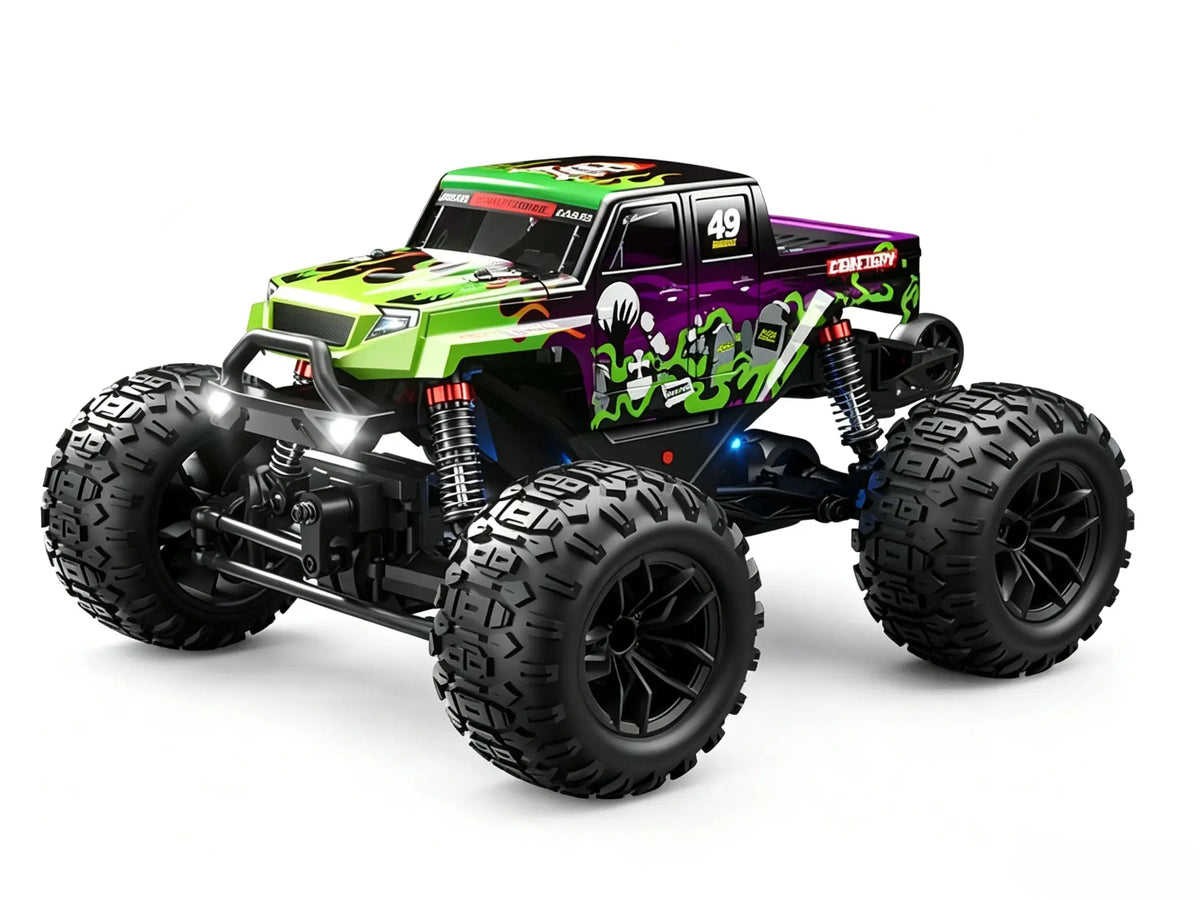
The 1:18 4WD RC Monster Truck runs up to 24 minutes per charge and reaches 19 mph.
Two figures make the case for this age band:
-
19 mph top speed. Fast enough to feel exciting in a driveway, slow enough that a young child can learn throttle control without a physics lesson from a curb.
-
24 minutes of run time on the supplied 7.4V 1500mAh battery — near the top of the 12–30 minute range documented across this guide, which means a real play session rather than a five-minute taste.
The 328 ft 2.4GHz range with proportional throttle gives finer control than a simple on/off trigger. ZD-pro lists this model as suitable for "RC beginners / Kids 4+," and it carries four built-in protections (over-current, over-voltage, low-voltage, and over-temperature) — a practical detail when the driver is still learning where the obstacles are.
Check the 1:18 4WD RC Monster Truck →
ZD-pro 1:20 4WD RC Off-Road Truck with LED Lights
Slightly smaller and built for the beginner end of the market. Its headline number is the strongest argument for it as a first gift: 30 minutes per charge on a single battery — the longest run time in this guide, and at the ceiling of the 12–30 minute range the category delivers.
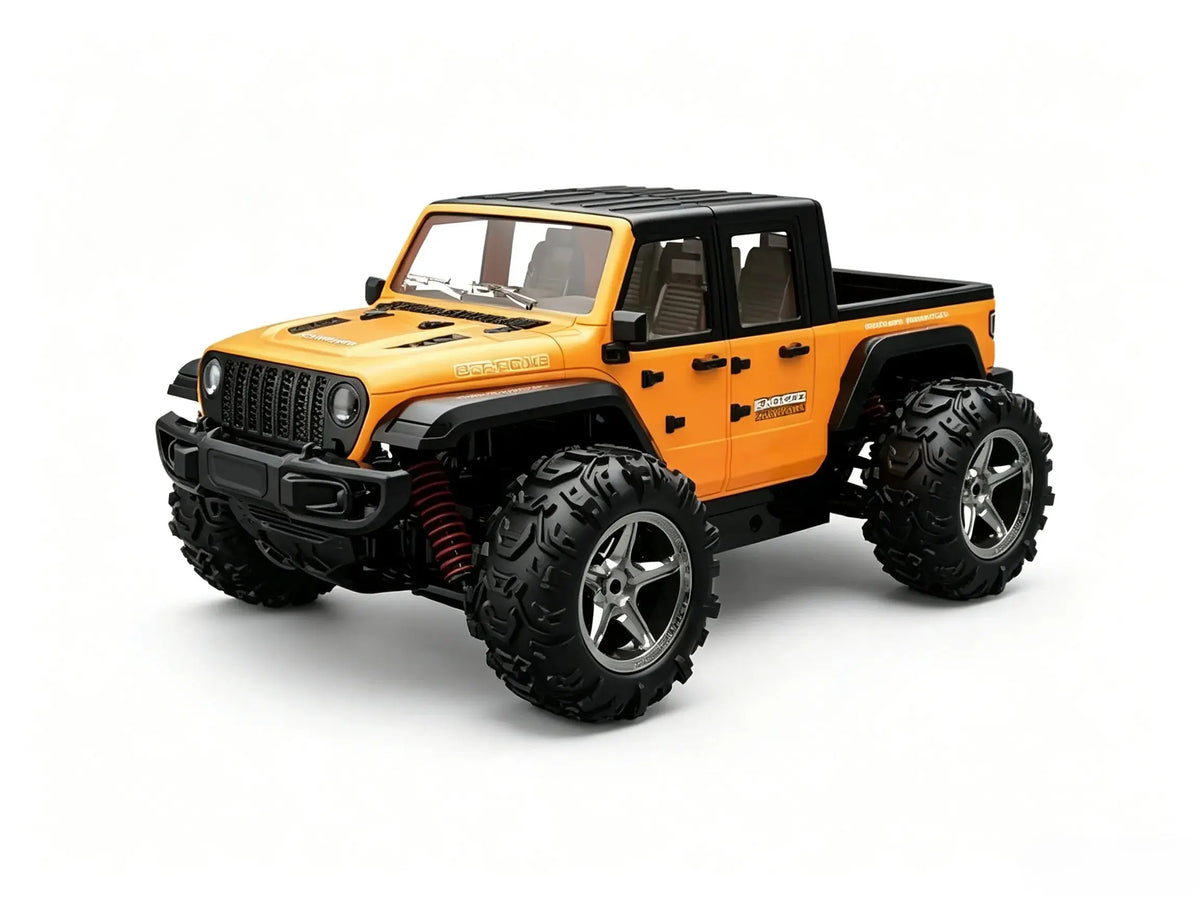
The 1:20 4WD Off-Road Truck offers a 30-minute run time and remote-controlled LED lights.
Everything else is calibrated to a young driver:
-
21.7 mph top speed — a modest step above the 1:18 truck, still well inside controllable territory.
-
164 ft remote range, roughly half the 1:18's 328 ft. That is a deliberate trade, not a downgrade: a child who will not be driving far from a parent does not need the extra range, and the shorter link is easier to manage.
Nylon differential gears and independent spring shock absorbers give it a smoother ride over grass and gravel than its price suggests, and the LED lights are controllable from the remote. The product page describes it as suitable for teenagers and adult hobbyists as well as casual outdoor play — evidence that it is a gift with room to grow rather than one outgrown in a season.
Check the 1:20 4WD RC Off-Road Truck →
Shopping for a 4–6 year old?
Both picks above ship with the battery and charger included. The 1:20 Off-Road Truck is the longest-running model we make at 30 minutes per charge — the best choice if your child hates waiting between sessions.
Ages 7–9: Faster, Bigger, More Capable
Once a child can steer reliably, the appeal shifts to speed and terrain. This is where four-wheel drive and larger scales start to earn their place.
The scale table supports the move: at 1:16 a car is roughly 9–13 inches long, comparable to a dinner plate, and independent guides classify 1:16 as "Very easy" to control and suitable for "beginners" with "light outdoor and indoor" use. In other words, a 7–9 year old stepping up from 1:18 is still inside the band the industry considers beginner-friendly.
Source: VRX Racing scale-size guide.
ZD-pro 1:16 4WD All-Terrain Waterproof RC Monster Truck
This is the most interesting pick in the guide because the two power levels are documented on the same product page, which turns a vague "get the fast one" instinct into a measurable comparison:
The 1:16 4WD Waterproof Monster Truck is available in brushed (24 mph) and brushless PRO (44 mph) versions.
|
Version |
Motor |
Top speed |
Remote range |
|---|---|---|---|
|
Standard |
Brushed |
24 mph |
262.5 ft |
|
PRO |
2840 brushless |
44 mph |
393.7 ft |
For a seven- to nine-year-old, the brushed version is the sensible starting point — and the brushed/brushless table above explains why: the brushed motor is the cheaper part to replace, and at 24 mph the standard version already nearly doubles the 19 mph of the 1:18 truck.
The physical details support the age band too. At 2.1 lbs it sits comfortably inside the published 1.5–4 lb range for 1:16 models, and it includes a wheelie bar, a rear wing, and LED headlights with three adjustable modes. Waterproof electronics and off-road tires handle dirt, grass, and gravel.
The upgrade logic is the strongest argument for this pick: if the child takes to it, the same model exists a step up — so the upgrade path is already proven rather than a gamble on an unfamiliar brand.
Check the 1:16 4WD Waterproof RC Monster Truck →
ZD-pro 1:16 4WD RC Crawler Pickup Truck
A crawler is a different kind of fun from a monster truck. Instead of raw speed, it is about climbing — slowly and deliberately conquering rocks, roots, and steps.
The 1:16 RC Crawler Pickup Truck comes in track-wheel and hollow-tire versions with independent suspension.
This 1:16 pickup is offered in track-wheel and hollow-tire dual versions with independent suspension. The independent guides make the case for the category itself: 1:16 scale is described as "compact enough for most vehicles' trunks," and crawler-style driving is the one discipline where low speed is not a compromise but the point — a child learning on a crawler develops throttle precision that transfers directly to a faster car later.
Source: RC Cars Guide scale chart.
For a child who enjoys building obstacle courses out of bricks and garden furniture, a crawler delivers far more play value than another fast truck — and that is an argument about how the toy will be used, not about its spec sheet.
Check the 1:16 4WD RC Crawler Pickup Truck →
Ages 10–12: Real Performance and Growing Skills
Older children can handle genuine speed, and many are ready for a car they can maintain and eventually upgrade.
This is also the age at which the maintenance economics of the brushed/brushless choice start to matter. A child who drives several times a week will put meaningful hours on a motor, and the lifespan gap — hundreds of hours for brushed versus 20,000+ for brushless — decides how soon a replacement is needed.
ZD-pro 1:14 4WD Monster Truck (Brushed & Brushless Versions)
The 1:14 scale is a meaningful step up in presence. Using the published table, a 1:14 model sits between the 1:16 range (9–13 in) and the 1:10 range (17–23 in) — noticeably larger than the 1:18 and 1:20 models above, and heavy enough to feel like real machinery.
The 1:14 4WD Monster Truck is sold in brushed and brushless versions across four colourways.
This model comes in both brushed and brushless versions, with a colour range that gives older children the choice that matters to them at this age. The brushed versions (14311 and 14312) are the sensible entry point; the brushless versions (14411 and 14412) deliver the extra speed and durability that a more experienced driver will notice immediately — and the 20,000-hour lifespan figure above is what "durability" means in practice here.
Check the 1:14 4WD Monster Truck →
ZD-pro 1:24 RC Drift Car with ESP Stabilizer
Drifting is one of the most rewarding skills in RC driving, and this 1:24 car is built specifically for it. Two of its specifications answer the obvious objection to buying a small car for a ten-year-old:
The 1:24 RC Drift Car uses an ESP stability system to correct drift posture automatically.
-
ESP stability system corrects drift posture automatically, which means a child can learn to slide the car through corners without the frustrating spin-outs that usually end a beginner's interest in drifting.
-
Low top speed is the point, not a flaw. At 12.4 mph, it is the slowest pick in this guide — but for a skill built on controlled slides rather than straight-line speed, that is a feature.
It uses a quick-release 3.7V battery, runs 15–20 minutes, and includes replacement drift tire sleeves. The 2.4GHz system allows multiple cars to race together without signal conflict — useful if siblings are both getting one. At 0.93 lbs it is the lightest car in this guide and among the most affordable.
One caveat, sourced honestly: independent guides warn that 1:24 models "can be fragile until you learn the hobby." That is a reason to pick this one for a child who already handles a car carefully — not necessarily as a first RC.
Source: RC Cars Guide scale chart.
Check the 1:24 RC Drift Car with ESP →
ZD-pro 1:16 4WD Brushless Off-Road Buggy
For a child who has outgrown entry-level cars entirely, this 1:16 brushless buggy is the performance pick. It is available in three colours and built for speed on dirt and short grass.
The 1:16 4WD Brushless Off-Road Buggy is the performance pick for experienced young drivers.
The brushless motor is the key difference, and the numbers explain it: 80–90%+ efficiency versus 75–80% for brushed, and a lifespan measured in thousands of hours rather than hundreds. Those two figures are what "built for a kid who is getting serious" actually means — more of the battery goes to moving the car, and the drivetrain does not need replacing mid-season.
Source: RC Fact, "Brushed vs Brushless Motors".
Check the 1:16 4WD Brushless Off-Road Buggy →
Beyond Cars: Other RC Gifts Kids Actually Play With
Not every child wants a car. The broader range covers several categories that work especially well as gifts — and the seasonal argument for each is measurable rather than a hunch.
RC Boats
A remote control boat turns a swimming pool into an afternoon of entertainment, and it is a gift that gets used in summer — when RC cars often sit idle in the heat. The RC Speed Boats collection and the RC Boats collection both cover this well, and the 2.4GHz RC Speedboat with long playtime at $64.99 is an accessible starting point.
If a child already has a car, a boat adds genuine variety for a modest cost — and it solves a specific problem: a car that needs a yard is useless on a beach holiday, while a boat is useless on dry land. Owning one of each covers both seasons.
RC Construction Vehicles
The RC Engineering Toys collection covers excavators, loaders, and dump trucks. These are a strong alternative gift for children who prefer building and digging to racing, and the 1:20 alloy excavator in particular is built from metal rather than plastic.
This is also the category the AAP's toy guidance speaks to most directly. Its "fine-motor/adaptive/manipulative" category — problem-solving toys such as blocks, puzzles, and trains — is documented as supporting fine motor skills and language and brain development. A working excavator with an articulated arm is that same muscle, just remote-controlled.
Source: AAP toy-selection guidance.
Stunt Cars
The Transform RC Stunt Cars collection covers models that spin, twist, and transform. They are not about speed or terrain — they are about spectacle, and they land well with children who enjoy watching a toy do something surprising. For that child, the honest advice is that a spec sheet matters less than whether the toy has a trick worth showing a friend.
A Note on Scale and Shared Spaces
One practical point that gift guides tend to miss: where the child will actually drive the car matters more than the specifications. The published size guides say this explicitly — "the best one is the one that matches how and where you actually drive, not the biggest number on the box."
Source: RC Cars Guide scale chart.
The space mapping is concrete. Independent guides give an explicit recommendation for households with limited room:
-
Limited space (apartment, small yard): 1:24 for crawling, or 1:28 for indoor racing — "both are genuinely capable and run comfortably indoors."
-
1:16: "compact enough for most vehicles' trunks," but "can feel underpowered on thick grass."
-
1:7 and above: "genuinely requires open space to appreciate."
Source: RC Cars Guide scale chart.
Applied to this guide: a 1:10 model is a wonderful gift for a family with a large yard, but in an apartment it is too big and too fast to use safely indoors, and the child ends up frustrated. For apartments and shared courtyards, the 1:18 to 1:24 range is far more usable.
If you are unsure, the RC Drift Cars and RC Crawlers categories both skew toward the smaller, indoor-friendlier end of the range.
What to Check Before You Buy
A short checklist, based on the questions that come up most often. Each line is something you can verify before you pay, not a general caution:
-
Does the remote need batteries? Most ZD-pro remotes take two AA batteries that are sold separately.
-
Can you buy spare batteries? Since the models in this guide run 12–30 minutes per charge, a spare is the single cheapest way to extend a gift's usefulness.
-
Is the model splash-resistant or fully waterproof? These are different things. Check the specification rather than assuming.
-
What does the warranty cover? ZD-pro RC cars and boats carry a 30-day limited manufacturer warranty covering factory defects. It does not cover crash damage or normal wear on tires, body shells, gears, and brushed motors — which is standard for the category, but worth knowing in advance.
-
Are replacement parts available? This matters most for the brushed motors noted above, which are wearing parts by design and the cheapest component to swap.
Watch Them in Action
Specifications tell you what a car can do. Watching one run tells you whether a child will love it — and it is the fastest way to judge whether a 19 mph truck or a 44 mph buggy suits a particular kid.
Here is a look at how these models perform in real use:
Follow along: we post real-world footage of these models on Instagram — short clips of the 1:18 and 1:20 trucks in the driveway, and the brushless versions opening up on open ground — at @rc_racer_jake. It is the quickest way to see how each model actually drives before you buy.
Can't see the embedded clips? View them on Instagram.
Embed slot 1 — 1:18 / 1:20 outdoor clip. Paste the Instagram embed code here. A 20–40 second clip of the 1:18 4WD RC Monster Truck or the 1:20 Off-Road Truck driving on gravel or grass.
Embed slot 2 — brushless speed demo. Paste the Instagram embed code here. A short clip of the brushless 1:16 Buggy or the 1:14 Monster Truck running at full speed, for readers shopping the 10–12 age band.
Frequently Asked Questions
What age is an RC car suitable for?
It depends far more on the individual child than on a fixed age — but the two can be reconciled. ZD-pro lists its 1:18 monster truck as suitable for children aged four and up, and describes the 1:20 truck as appropriate for teenagers and adults as well. Independently, scale-size guides recommend 1:18 as the sweet spot for "kids under 10" and warn that 1:24 models "can be fragile until you learn the hobby." Combining the two: ages four to six suit slower 1:18–1:20 models, ages seven to nine can handle 1:16 with four-wheel drive, and ages ten and up are ready for 1:14 and brushless performance.
Is a brushed or brushless motor better for a child?
For a first RC car, brushed is the better choice. It is cheaper to replace, and it is slower in a way that helps a beginner learn. Brushless is worth the extra cost once the child can already drive without crashing constantly — the measurable advantages being 80–90%+ efficiency versus 75–80%, and a lifespan of 20,000+ hours versus hundreds.
Source: RC Fact, "Brushed vs Brushless Motors".
How long do RC car batteries last?
Looking at the seven models in this guide, run time ranges from about 12 minutes on the smallest 1:24 drift car to 30 minutes on the 1:20 truck. Buying a second battery is the simplest way to double a play session — worth noting because these packs are LiPo, so spares should be stored and charged per the safety guidance linked above.
Can children drive RC cars indoors?
Smaller models can, with care. The published space guidance is specific: for limited space such as an apartment or small yard, 1:24 or 1:18 models "run comfortably indoors," while larger 1:10 and 1:12 models need outdoor space. If the gift is intended mainly for indoor use, choose from the smaller end of the range.
Source: RC Cars Guide scale chart.
What happens if the RC car breaks?
Contact support with your order number and clear photos or video of the issue. If it is confirmed as a factory defect and within the 30-day warranty window, replacement parts and technical guidance are provided. Buyers install the parts themselves following that guidance. Outside the warranty window, the parts most likely to wear — tires, shells, gears, and brushed motors — are also the cheapest to replace.
The Bottom Line
The best RC car for a child in 2026 is not the fastest or the most expensive one — it is the one that matches the child's age, the space they have to drive in, and how much patience they have for learning. That is not a slogan; it is what the numbers in this guide point to, from the 8–10 inch footprint of a 1:18 car to the 20,000-hour lifespan of a brushless motor.
For most families, the safest gifts are the 1:18 4WD RC Monster Truck for younger children, the 1:16 Waterproof RC Monster Truck for the seven-to-nine range, and the 1:14 Monster Truck for older children ready for real performance.
Still deciding? Two ways to narrow it down.
• Buying for one child: match the age band above and pick the model in it that fits your space. • Buying for several: the Holiday Bestsellers and Best Sellers collections both ship before the holidays and cover every price point from the $54.99 drift car to the $149.99 brushless buggy.
Disclosure: This guide is published by the ZD-pro RC team. We describe products from our own range, and specifications are taken directly from our product pages — figures you can verify at the linked URLs. Where our own data is not enough to support a claim, we cite independent scale-size guides, motor-comparison references, LiPo safety guidance, and the American Academy of Pediatrics. We have flagged limitations honestly — including what our warranty does not cover — because a gift that suits the child matters more to us than a sale that does not.


